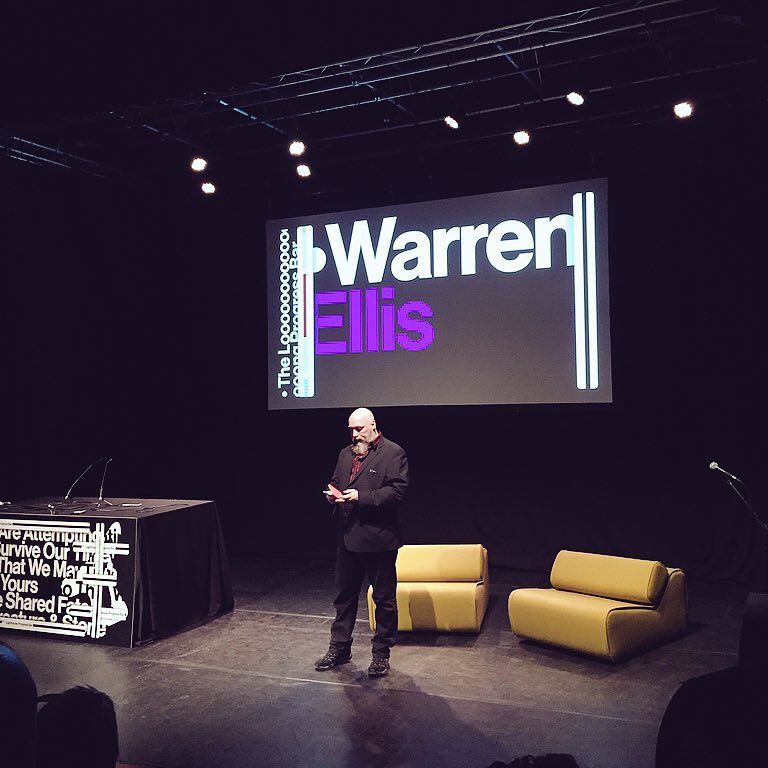
Gin And The Cognitive Surplus

April 28th, 2008 | researchmaterial

The best fifteen minutes from Clay Shirky I’ve yet seen:

24 Responses to “Gin And The Cognitive Surplus”

  1. Yes, he is so right.

  2. Yes, but he’s describing something that affects, and will always only affect, a minority.

  3. I’m not so sure about that minority thing, Allen. You can go to places like Ghana and find cellphones and such EVERYWHERE. While dissemination may take a while, there’s very little needed to be able contribute like Clay’s suggesting. Besides, this industrial capitalist thing we’ve currently got is unsustainable. I’m betting we’ll see a more even distribution of wealth in the next few centuries. If we don’t kill each other before then.

  4. That was great! The phrase “cognitive surplus” so perfectly describes some vague concepts in my mind–nice to finally have a name for it!

    Seth, I agree, and I so hope you’re right about the even distribution of wealth bit. I’m not convinced, but I’m maintaining hope…

  5. It strikes me as somewhat ironic that I’m watching this in a largely non-interactive format. A good piece of thought, however. I’ve been watching the TED conference videos lately and it’s struck me that they need an interactive sidebar, such that when someone mentions a website or a name that you can immediately cross-reference without having to note it down for later, or stop in the middle of watching the clip to locate your browser window or whatever. It’s still consumption, but it’s more active than just sitting there and letting it wash over you.

  6. @Waider - sounds like someone needs to set up a wiki :)

  7. Isn’t that the point of it though? We’re watching this video from different parts of the world and afterwards we can come here or to a forum or whatever and discuss and argue the points that he has to make. Which, I must say, are brilliant and certainly put into perspective a lot of free floating ideas I’ve had over the years. One thing I’ve definitely gotta say about this guy though is that he sounds and looks a lot like Tom Hanks. Not that there’s anything wrong with that.

  8. […] From Warren Ellis, a temendously interesting talk on ‘Web 2.0′, time and social development: […]

  9. […] course, and how they fit into this general idea of a “cognitive surplus”).  It’s a video of Clay Shirky, recent author of Here Comes Everybody, found (obviously) on Warren Ellis’ website (you may […]

  10. Well, at this point I think the interactivity is embedding the video elsewhere for sharing and discussion. (which I’ve done)

    “Media that ships without a mouse is broken…” I like that.

    Re: Minority connected to the web - that is changing and quicker than we think with foundations like One Laptop Per Child and so forth.

  11. Here Comes Everybody…

    As someone who works in a career sitting at the crossroads of Television and the Internet, Clay Shirky’s talk and essay elicit both nods and hand-wringing from me.
    Nodding because a lot of my personal “free time” is spent blogging, pl…

  12. […] Excellent and entertaining presentation from Clay Shirky. […]

  13. […] Undoubtedly, most of you who read my blog have already seen the links to Clay Shirky’s “Gin, Television, and Social Surplus” and here’s the video link. […]

  14. @Waider: Yes, the fact you were able to comment here and raise that point makes it that much better, more active than TV could ever be.

    Not that you couldn’t interact with TV. You’d just have to write a letter to the station, etc. and likely never get a response. Here, everyone who just watched this on this page can scroll down and see your contribution.

    It’s a remarkable way to look at. Makes me want to be even more careful with my commenting.

  15. “It strikes me as somewhat ironic that I’m watching this in a largely non-interactive format.”

    3rd leg of the stool. Production, Sharing, Consumption.

    Without the latter, the first two wouldn’t have anywhere to go.

    As to the relatively interactive/noninteractive nature of it - well, you’re looking at it in a browser. The accompanying dymanic reference, if you’re using the same browser I am, is in the top right corner with a wee blue G next to it.

  16. […] Making Sense of the Web 2.0 Revolution Talk by Clay Shirky: http://www.warrenellis.com/?p=5885 […]

  17. […] anymore. I’m quitting because there is no reason for Facebook to exist, because you suck up a cognitive surplus worse than all the sitcoms and soap operas on […]

  18. […] via Warren […]

  19. […] You can see Clay deliver it here. […]

  20. @Waider Check the twitter back channels for the interaction during the presentation. Personally, I focused on his presentation because I found an expression of some ideas I have been groping around in the dark.

  21. […] http://www.warrenellis.com/?p=5885 […]

  22. From Clay’s references, I’d say he and I are about the same age (40). He seems to forget that people have had free time for a lot longer than just post-WW II. (TV hit the masses in the 50’s–it was a novelty before then.) They had more free time in the 50’s, but not significantly more than the 40’s, 30’s, or 20’s. So how did people fill their free time before TV? They listened to radio shows, went to bars, movies, dance clubs, and other social events. Those board games Clay and I grew up on were preceded by parlor games, card games, dice games, etc. There were/are sporting events, carnivals, gambling,… The list of recreational pursuits is probably endless.

    He contrasts Wikipedia with television by saying Wiki is interactive, and participatory, whereas TV is passive. You can make TV interactive–ever watch Mystery Science Theater 3000? Ever seen a viewing of the Rocky Horror Picture Show? Ever heard of drinking games based on catch phrases? (e.g., when Mr. X says Y, take a swig). Yes, TV is normally passive, and it’s not the only passive thing we do–we watch movies, plays, musicals, or operas, we read books, magazines, or newspapers. (Watching sports can be a passive/active thing, depending on the sport–compare tennis or golf to football or soccer.)

    I would say that Wikipedia is a HOBBY of the creative type, like model building, R/C, or hotrod-ding. It’s the result of a million volunteers writing a report on their favorite subject, but writing at college level, to college-level requirements–”make sure your report is properly referenced and cited, and no plagiarism”. Over 100 million people have graduated from college since the end of WW II, and a small fraction of them liked writing reports, so it’s not surprising that Wikipedia can amass millions of articles.

    As social animals, a participatory and interactive Internet does appeal to us more than vanilla television, but there will always be people who like watching television, because people like listening to stories. Stories have been around as long as campfires, so television will not die. (It may contract, but it won’t die.) True, TV has distilled most of the social aspect out of storytelling (and story listening), so its loss of viewership is not surprising.

    However, people are spread across a passive/active spectrum, so some are more interested in participating and interacting than they are in listening and watching, but others are more comfortable with the solitude that reading or watching TV provides. What I’m talking about is the introvert/extrovert dichotomy, which is one of the most clearly defined axes of personality. With his concentration on social interaction, he is ignoring the introverts in society–probably because introverts tend to be quiet. If he can figure out how introverts fit into his revolution, then I will believe it more. Exclusive revolutions aren’t as successful as inclusive ones.

  23. Wow. That was longer than I expected. I hope I didn’t bloviate. If I could have said it pithily, it would have been something along the lines of “the world isn’t as simple as you think”. Clay has definitely identified some good ideas, but they’re just a few threads in the tapestry of Thoughtspace, and they may not be as critical as he thinks they are. Every time I think I’ve latched onto some linchpin in society, I learn that things are a lot more complicated. If societies were simple, they’d teach Social Engineering in college.

  24. […] Clay Shirky @ Web2.0 - Gin And The Cognitive Surplus […]

Miss Piggy?s Teaches of Peaches

Coilhouse - 20 Nov 09

Every time an issue of the magazine goes to print, things somehow turn Highly Inappropriate here at Coilhouse. This is apparent to anyone who was there on Twitter during the hours of our final revision deadline yesterday night. And it’s only going to get worse before Issue 04’s out. So to celebrate, a video of Miss Piggy singing “Fuckt the Pain Away” by Peaches. It’s that kind of day.

[via Shannon]


Post tags: Madness, Music, Puppetry

claytoncubitt: Will Blanche, ?The Newly Constructed Towers of...

Brian Wood - 20 Nov 09


claytoncubitt:

Will Blanche, ?The Newly Constructed Towers of the World Trade Center Seen From the South Side on West Street, May, 1973? (via These Americans)

See also: Mitch Epstein, ?West Side Highway, New York City? [looking towards World Trade Center] 1977

Percy Jackson trailer

Kung Fu Monkey - 20 Nov 09

Seriously, if I were 12, this would have melted my brain. I love this trailer.

JOURNAL: How to Break and Open Source Insurgency

John Robb - 20 Nov 09

Short Answer:  divide it.

It's long been my contention that Iraq was stabilized at an acceptable level of controlled chaos due to a happy accident by al Qaeda (in an attempt to expand/lead the loose insurgency in a new direction).  What did they do?   They blew up the Golden Mosque in Samara in 2006.  This act of symbolic terrorism did indeed disrupt social networks as anticipated, however the consequences were ultimately disastrous for the Iraqi open source insurgency.  

Baghdad_Ethnic_2007_late_smThe reason for this is it broke the dynamics of the open source insurgency in ways the US and Iraqi government's COIN efforts could not.  First, it created a permanent split between Sunni and Shiite insurgent groups/militias.  Coopetition ended.  Second, it motivated large Shiite militias to start an ethnic cleansing of Sunni areas.  This put acute pressure on Sunni guerrilla groups who were too small (by design to avoid US counter-pressure) to defend themselves against large militias operating in the open.  The result was an opening, very close to the one I described in my 2005 NYTimes OpEd, that allowed the US to convert Sunni guerrilla groups into militias that were not loyal to the central government (in direct contradiction to its COIN manual).   

It's a nice example of the dynamics of many to many conflict, social network disruption, and the development open source counterinsurgency.

See this excellent description at the blog, "Musings on Iraq" for more detail on the ethnic cleansing operations.  It also includes this money quote: "the majority of the Sunni insurgency gave up and switched sides to align with the Americans rather than face annihilation at the hands of the Shiite militias, Al Qaeda in Iraq, or the United States."

NOTE:  it's pretty clear from the above that social network disruption (either through attacks on symbolic targets or blood and guts terrorism) is like playing horseshoes with live hand grenades.  It's ultimately a losing strategy for advancing an open source insurgency.  Social network disruption is very likely to break standing order 6:  don't fork the insurgency.

Twitter Updates for 2009-11-20

Girl Farts - 20 Nov 09

LINKS: 20 NOV 09

John Robb - 20 Nov 09

Some random items of interest:

  • Vigilante militias in Rio are displacing the drug gangs -- favelas under the control of militias has grown from 108 in 2005 to 400 in 2008 (out of 965).  Why?  They have a better (albeit parasitic) conflict/business model than the drug gangs since they act as a substitute for missing public goods/services normally supplied by the government.  First, they provide a minimal level of security and conflict adjudication.  Second, they make more money than the drug gangs by "taxing" everything from propane to cable TV to the gray market.  
  • US gray economy estimated at $1 Trillion (not including criminal, outside of the evasion of taxes and regulation, activities) and growing faster than the "legal" economy.  
  • Proposal and wiki for an open source fabrication lab.
  • Somali pirates are expanding operations into the Indian ocean.  The combination of positive feedback loops (maritime insurance + rapid payoffs by crisis negotiators) and legal ambiguity (the biggest fear of a western navy and governments is that they might arrest a pirate -- prompting a massive/expensive legal tussle with few certain penalties and the forced extension of a visa to the former pirate once he is released from his short incarceration).  Is a franchise model for other locales possible?
  • Yes-we-can-secede
  • A business group in Ciudad Juarez asks for UN peacekeepers.  Hilarious. "Ciudad Juarez, population 1.5 million, has an average of seven homicides a day, with the total at 1,986 for this year through mid-October."
  • Seccession.net.  County based secession effort.  

Untitled Post

blissblog - 20 Nov 09

Yume no Byouin Project

Jean Snow - 20 Nov 09

Yume no Byouin Project

Beautiful (and simple) site design featuring the illustrative work of Yorifuji Bunpei. Via Paul Baron.

Kodai

Jean Snow - 20 Nov 09

Kodai

Coming up at the Kakitsubata gallery in Nakameguro is the show “Kodai,” running from November 25 until December 6.

Kodai

Kap Bambino

jwz - 20 Nov 09