6. Good From Strontium

May 16th, 2011 | spirit tracks

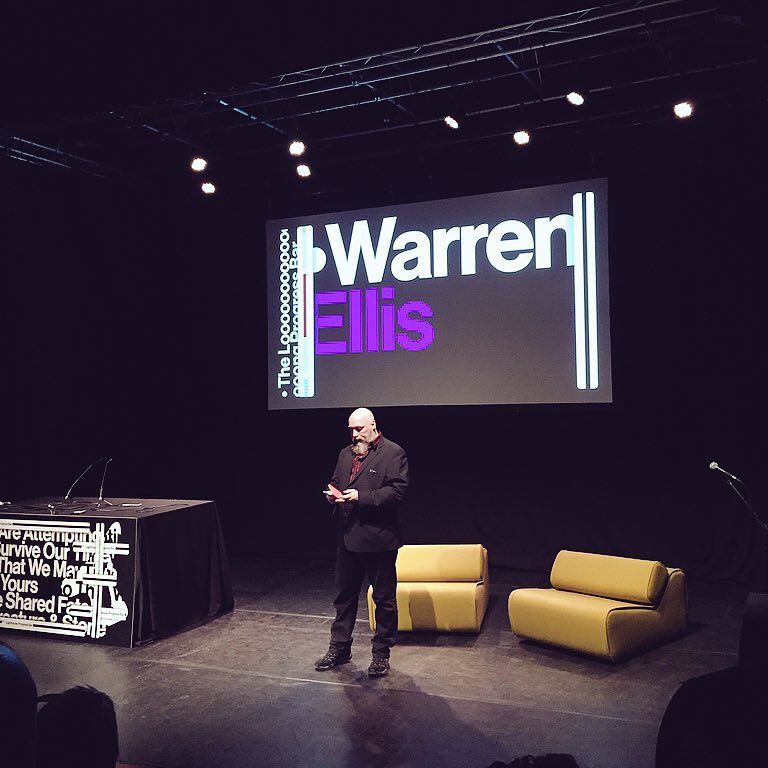
February 2011, Berlin: I’m standing on a stage, a comics writer in front of a room full of digital-cities people who don’t really know who I am or what I’m doing there, and I’m saying this:

I’m mostly a science fiction writer. Steven Shaviro, in his book CONNECTED, talks a bit about the Russian sf novel ROADSIDE PICNIC, saying that it, like all science fiction, actually exists to cast a shadow over the present.

He says of science fiction, "It shows us how profoundly haunted we are by what has not yet happened.”

In the specific case of Roadside Picnic and Tarkovsky’s film adaptation STALKER, what had not happened yet was the Chernobyl disaster. The alien impact region called The Zone in STALKER has crossed over into reality to become Chernobyl’s actual Zone Of Alienation, and the guides who take the curious into it call themselves Stalkers. In 2007, a videogame called S.T.A.L.K.E.R explicitly associates Roadside Picnic and STALKER with Chernobyl and The Zone Of Alienation, to the point where photography and footage of The Zone Of Alienation became the basis for the visual depiction of The Zone.

According to a 2003 report, there are two "cafes" inside the Zone that serve vodka described as "good from strontium." The report, preserved on a yabloko.ru message board, also notes:

Bread and vodka remained as “currency" for Chernobyl till now, where long ago is built its own, radiation communism

Which I mention purely because I love the term "radiation communism."

And I’m reminded of the ongoing experiments in particle physics that currently seem to indicate that the present is influenced by the future, where entangled photons tell each other what’s going to happen before it happens.

But I’m here to talk about the haunting. I’m here to talk about the ghosts.


5. A Brief Pause In 1978

May 16th, 2011 | spirit tracks

An aside, from 1978: Tony Wilson and Alan Erasmus, not quite yet having formed Factory Records in Manchester, put together a band out of bits of other local bands. Wilson would have been entirely aware that that the title RETURN OF THE DURUTTI COLUMN deliberately misspells the name of Spanish anarchist Buenaventura Durruti, but names the band The Durutti Column. Mostly, I suspect, so he can call the first album RETURN OF THE DURUTTI COLUMN. A well-read man, Wilson employs another Situationist notion, and sells the record in a sleeve made of sandpaper, so that it will slowly destroy the other records in the owner’s collection.


4. Raudive

May 16th, 2011 | spirit tracks

1966: and Dr Konstantin Raudive is listening to the radio. He is inside a Radio Frequency (RF)-screened laboratory. He is hunched over the radio, a microphone, and a tape recorder, listening intently to a dead frequency in the medium band. He is listening for the voices of ghosts. Electronic Voice Phenomena: the idea that the dead are speaking to us through radio, somewhere down deep in the medium wave, around 29 megacycles.

Today, EVP is more commonly termed Instrumental Trans-Communication by the ghost hunters of the world: informational traffic between the spirit world and any electronic device. Including, of course, networked digital devices.

This is all going somewhere. Really.


3. Report On The Construction Of Situations

May 16th, 2011 | spirit tracks

1966. University of Strasbourg Student Union funds are lifted by Situationist sympathisers to print Andre Bertrand’s short comic RETURN OF THE DURUTTI COLUMN, which used stills from Hollywood movies in a process then termed detournement: familiar materials recontextualised in opposition (or at strange angles) to their original intent. This is something so common on the internet now that most people may not know there’s a word for it. It became “culture jamming,” and now it’s simply the way we piss about on the net and do our artistic business. It’s one of the keys to cultural atemporality – everything is detourned, everything is collage, everything needs prior art. Everything is ghostly fabric. The only useful Google hit I can find for Andre Bertrand today is, funnily enough, the Wikipedia page for an attorney who specialises in copyright law.

(The Student Union’s next stunt is to release a polemic notable for praising Spies For Peace. The British anti-war group The Committee Of 100 was affiliated with Spies For Peace. Comics writer Grant Morrison’s father did prison time as a member of the Committee. Committee-related demonstrations against Greek royalty visiting London in 1963 led to the arrest of, among others, comics artist Donald Rooum (whom I knew in the 1980s as a sweet and lovely illustrator of kids’ comic strips – it was quite a shock when I later discovered him doing anarchist comics). Donald was nicked and framed by one Det. Sergeant Harold Challenor, who was later found to have been a functioning paranoid schizophrenic since approximately 1944.)


2. 1966 And All That

May 16th, 2011 | spirit tracks

It’s also 1966, as I write this in 2011. In 1966, Delia Derbyshire pays for Pink Floyd’s taxi as they visit her at the BBC Radiophonic Workshop. Pink Floyd’s Syd Barrett is months away from going mad. Philip K Dick publishes NOW WAIT FOR LAST YEAR. (Last year was the pirate TV broadcast from Sunk Head, in international waters.) Yoko Ono is months away from being naked on Delia Derbyshire’s floor for no particular reason. The INTERNATIONAL TIMES recently commenced publication, launching at a Pink Floyd gig. (Radio Tower is now broadcasting spottily from Sunk Head.) The film THE WITCHES, written by Nigel Kneale, has been released. And issue 7 of radical architecture magazine ARCHIGRAM is published, under the theme of “beyond architecture,” packaged with a resistor, to denote, in the words of Archigram member Dennis Crompton, the “end of the Faraday era, if you like, where the ways of processing electrons were through valves and various devices that were based on late Nineteenth century discoveries.”

Crompton goes on to describe one piece of the magazine, as written by Warren Chalk: “it’s a letter from Warren to David about ghosts and phantoms. And again, it’s Warren thinking out loud, as you might say, thinking that ghosts are his memories of the past in architectural design and music and social events, and the phantoms are from the future.”


1. Spirit Tracks

May 15th, 2011 | spirit tracks

This is a very short book being written in several times at once. I’m writing it in May of 2011, but I’m also writing it in January 2011. In January 2011, it is taking the form of a talk. I’m rewriting it in February 2011, just before giving the talk, in Berlin. Bits of it are being written in 2010, and at those points I have no idea that they’re part of any kind of book.

The skeleton is the keynote talk I gave at a conference about the emergent digital nature of cities. Everything else is… everything else I was interested in at the time. It is a book about how everything is electric. It is also a book about cities, and a book about broadcasting, and a book about science fiction. And it is a book about ghosts.

The chances are good that it will make no sense at all.

Sunk Head, by the way, was blown up with more than two tons of plastic explosive in 1967. The light and heat from the blast could be seen and felt more than fourteen miles away.


0. Sunk Head

May 15th, 2011 | spirit tracks

Pirate television used to be a science fiction signifier. MAX HEADROOM, for instance. Its overwhelming mediapocalyptic televisionscape may kindly be considered prescient, if not obvious, but one of its more charming elements was the pirate tv station Big Time, run from a converted Winnebago by ancient British punk Blank Reg. The first MAX HEADROOM tv film, aired in 1987, was subtitled 20 MINUTES INTO THE FUTURE. Pirate television was already 22 years old. The first pirate television broadcast that I know of was transmitted from Sunk Head, an illegally-occupied Sea Fort off the coast of Essex.

On 9 November 1965, at around 4.20 in the morning, a hundred-foot aerial atop the four-storey-high Sunk Head tower chucked a signal across eleven miles of water and fourteen miles inland. The broadcast was reportedly a still image, ghostly and monochrome: a white globe with a star and two Ts atop it, and the name of the nascent pirate tv station: Tower TV.

Sometimes I think that the real world was always moving faster than science fiction: it’s just that back then the real future was broadcasting at 4.20 in the bloody morning and no-one was around to see it.