A Non-Fiction Book

September 20th, 2012 | Work, spirit tracks

This was the post at Publishers Marketplace:

Author of RED, CROOKED LITTLE VEIN and forthcoming GUN MACHINE, Warren Ellis’s SPIRIT TRACKS, about the future of the city, the ghosts that haunt it and the science-fiction condition we live in, to Sean McDonald at Farrar, Straus, by Lydia Wills at Lydia Wills (world English).

That’s Farrar, Straus & Giroux, an incredibly impressive publishing house with an incredibly impressive list.  Lydia’s an absolute miracle worker.

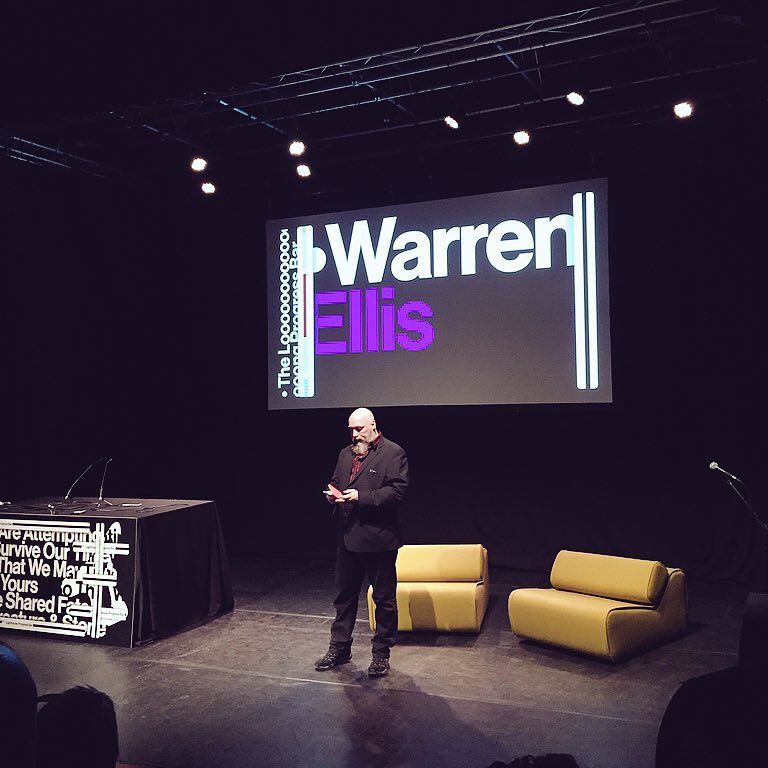
SPIRIT TRACKS is the working title of a book based upon the talk I gave in Berlin last year, which appeared here, in its original waytoolong form, in twenty-nine parts.

So… this is happening.  I am writing a serious non-fiction book for a serious non-fiction list.  Which is kind of strange, isn’t it?  As I said a few weeks ago, the career’s gone in an odd direction again over the last few years.  Sometimes I wonder if people will look back over my CV and ask themselves what the hell I thought I was doing.

I start this book next year, after I finish the current novel.  It may or may not have the same title when it’s announced as going on the publication schedule.  Really looking forward to working with Sean McDonald, who’s edited some of my favourite non-fiction over the last several years, including Steven Johnson’s magnificent GHOST MAP.

I’m a novelist and a non-fiction author now.  Strange days.


29. Our Streets

May 20th, 2011 | spirit tracks

There’s no such thing as ghosts. UFOs are just lights in the sky. And vodka is probably not improved by strontium. None of that matters as much as the decision you have to make before you start to make the future, before you get carried away by the lights in the sky and the things you can do with your glowing boxes. Whose streets are these, that you’re going to be building your cognitive cities on?

Whose streets? Our streets.

Ultimately, this conference I’m standing at in Berlin, these people I’m talking to, might turn out to be a conference of people who are hunting a ghost.

It’s your job to make that real.

It’s my job to remind you that I’m haunting you.

Thanks for your time.

- end -


28. The Maiden

May 20th, 2011 | spirit tracks

Listen to what the ghosts are telling you.

A man called James Douglas gave the Maiden, an early form of guillotine, to the court of Mary Queen Of Scots in the 1500s. Legend has it that he was also the first person to be executed with it.

As a rule, Western societies tend to need people like you to give the concepts behind digital cities to them.


27. The Locks

May 20th, 2011 | spirit tracks

Governments and corporations colluded to shut off mainline internet and phone service in Egypt, but a couple of hundred people running TOR bridges kept the information moving. Now, maybe you’ve all been having conversations about tying countless services into a digital-city infrastructure and then giving them keys to someone else and how that would work when that’s centralised and some complete strangers now operate the locks.

If you really want to talk to digital ghosts on the streets of your cities, you may end up holding ad hoc digital seances. With your ghost boxes boiling your brains.

A bit of, in fact, radiation communism.


26. Best Case Scenario

May 20th, 2011 | spirit tracks

Ever been to Iceland? The Icelandic government spend a hideous amount of money on fireworks every year. But the road out of Keflavik is still a dirt track. These are the people who’re going to fund your new digital infrastructure? They can’t build fucking roads. Our authorities are sometimes at their most benign when they’re at their most incompetent.

As I was writing this, Laurie was sending through reports and photos of kids being beaten by police on the streets of London via her ghost box. Because Western societies don’t, yet, switch off the internet and the mobile phone network when they want to beat the shit out of their populace. And I often think that it’s not that they don’t want to, so much as they are old and slow and haven’t quite figured out the way the world works yet. Ten years ago in Britain, there was a great outcry when speed cameras became ubiquitous on our roads. Lots of talk of 1984, Big Brother. But the anger kind of died away when it was later found that, not only were the cameras not digital, but that most of them didn’t have any film in. The county of Norfolk had no film in any of its speed cameras for the whole of 2001.

And that might be the best case scenario.


25. Flyposting Is Illegal

May 20th, 2011 | spirit tracks

Flyposting is illegal. Google Maps pins and AR anchors are not.

Cognitive cities require the approval and collaboration of city authorities. The same people who make flyposting illegal.

Spirit roads were overlaid on folkloric paths believed to be travelled by ghosts. It seems oddly apt to me, here in our hauntological future condition, that we might superimpose ghost traffic on our real roads.

Opening the streets to spectral detournements, applying digital sandpaper to the real world, and the fictions of ARGs, Alternate Reality Games. Pirate broadcasting from the husks of old buildings again, like those Essex nutters sending pictures to televisions at four in the morning.

Mediated by ghost boxes, enabling near field instrumental trans-communication with the world of the invisible. Electric scrying pools, a glowing screen for conversation with the voices of the other side.


24. Report On The Situation Of Constructions

May 19th, 2011 | spirit tracks

It’s why some of the digital cities rhetoric is turning more and more to evangelism, partnering with civic authorities, trying to influence the actual owners of bricks and mortar and street furniture. Explaining it. Giving the gift of the digital city to our ruling classes. Which is many places isn’t getting further than, say, publicly posted building permits in New York City having QR codes printed on them. Which will be great until someone steals the permit to make a crack pipe out of it.

Those RFIDs won’t be ours. They’ll be corporate agents of one kind or another. There’s an artist who’s recently made small ripples by cementing USB sticks into the exteriors of buildings, but any intervention will remain on that fairly tiny scale.

Any physical intervention.


23. Whose Streets

May 19th, 2011 | spirit tracks

As I was working on the first draft of this, students were tearing through central London en masse and yelling “Whose streets? Our streets!”

Journalist Laurie Penny was out in the middle of them with a phone, reporting in through Twitter. I was keeping an eye on Twitter as I wrote this, actually, so I could shout at Laurie (who has the self-preservation instinct of a lemming dipped in vodka) occasionally. (She recently cited me in an interview as a provider of “avuncular advice.”  She did not add that she never fucking listens to it.)

And it occurred to me that they’re not our streets. In the sense that we can’t build in them.


22. Psychosonic

May 19th, 2011 | spirit tracks

The ghost box is also a symbol of hauntology.  Ghost Box is the name of one of the pre-eminent music labels associated with sonic hauntology: a music that traffics in the ghostly, in the peculiarly unsettling early electronic music of the Sixties and Seventies, in the strange common culture of 70s British television, in the ejecta of the collision of the rural and folkloric and the electronic and modern.

One touchstone is the children’s tv series THE CHANGES, where a return to primitive non-technological life (or perhaps Terence McKenna’s much-discussed notion of an Archaic Revival) is triggered by the emitting of psychosonics from those great rusting pylons.  The sound makes people want to smash technology, and, after everything has been smashed, the pylons are so repulsive to people that they’re driven (down old tracks?) into the countryside.

(I like to think of Jack Schulze cowering under one, yelling “No!  Fuckers!”)

The music for this series was created by Paddy Kingsland, of the BBC Radiophonic Workshop.  He joined the Workshop in 1970.  Delia Derbyshire was still there, not having yet flown off to become, among other things, a radio operator.  Not quite having closed her first career in music, but getting there.  She’d been a catalysing point for electronic sound in the Sixties.  She’d talked to Pink Floyd, the Beatles, the Stones, and apparently had an orgy with Yoko Ono and other persons unknown on her own living room floor.

“I was always very generous in telling people everything I knew,” she said.

And when everyone knew everything she knew, it seems that it was decided that there was no great use left for her.  And so she left, to become a ghost of electronic sound for some twenty years.


21. Conversations With Things

May 19th, 2011 | spirit tracks

You know what a ghost box is? They pre-date EVP. It’s said that Thomas Edison tried to make one once. There’s a whole community of ghost box makers on the net today, right alongside the ghost detector people and the Instrumental Trans-Communication people (add ITC to EIF and RFID). A ghost box is an electromagnetic device for communicating with ghosts through radio waves. Some ghost boxes claim two-way communication, in fact. Conversations with things that are not alive as we commonly understand the word “alive” to mean.

I imagine most of the people here at this conference in Berlin have one of those in their pockets.

And by “conversations with things that are not alive” and all that, I don’t mean phone calls with family members and dumped boyfriends.

That’s a bit of a mundane digital-city future, though, I suppose – having to communicate with the ghosts through a glowing box. And also a bit expensive for many city dwellers, I would think. Although possibly I’m just cheap.


20. Corpse Flightpath

May 19th, 2011 | spirit tracks

Spirit tracks.  Spirit roads.  Ghost roads.  Corpse roads.  Lych ways.  The Leichenflugbahn, which means, gorgeously, “corpse flightpath.”

Ghost roads appear, quite simply, to be the paths through which dead bodies were carried to cemeteries.  But, even as digital cities will be built atop the base matter of the contemporary city, ghost roads were superimposed over old geographies.  Corpse roads took the paths that ghosts and other numinous beings were already known to pass down.  Spirit tracks, in German folklore, were imbued with “the magical characteristics of the dead.”  

Spirit tracks.  The roads of ghosts.  Magical characteristics.

These haunted streets could be interrogated, too.  Devereux writes of a crossroads in Iceland where the interested hauntologist could “summon the spirits of the dead from the church cemeteries and they would glide up the roads to the crossroads where the seer could divine information from them.”

He also notes my favourite, “stile divination”.  In Cornwall, apparently, ghosts liked perching on country stiles in the path of spirit roads, and one could sit there and interrogate them as they go.  A stile is an RFID reader for dead people.


19. The City Is There To Haunt Us

May 18th, 2011 | spirit tracks

Take one street. A digital spirit track. Antenna ghosts whispering at us. All of us experiencing an ethereal presence in the street. Because our brains are being magnetically boiled by a constant blooming of experience inducing fields from everywhere.

I am in Berlin, standing in front of a few hundred people involved in the theory and planning of the digital cities of the future, and saying to them: Is this what you want to do to us? You fucking monsters.

(I got a laugh.)

The city is there to haunt us.

Perhaps we might hold up our phones, and see the spirits on the screen, through the camera, via an AR (Augmented Reality) application. Seeing the spirit track on our ghost box.


18. EIF

May 18th, 2011 | spirit tracks

RFID tags are well on their way to ubiquity. They’re going to get more complex. They’re going to use more power to achieve that. They’re going to be bloody everywhere. Your phones will talk to them (some do already). These large, weak magnetic fields are going to bloom invisibly all over the place. A ghost world of inaudible machine chatter.

Imagine if they got strong enough and complex enough to repeat the Persinger experiments with. Researcher Jason Braithwaite calls that kind of field EIF: Experience Inducing Fields. RFID EIF. eIF. Maybe there’ll be eIF for your iPhone one day. Perhaps it could talk to you: EIF EVP. Or maybe your Nexus phone, with its NFC capability. NFC eIF.


17. Whisky Again

May 18th, 2011 | spirit tracks

Whisky again.  Jack Schulze again. He sat down with me a couple of years ago while I was very drunk (it was the WIRED UK magazine launch, and the whisky was unwisely free) and showed me some footage on his phone. He’d been in Norway with Timo Arnall (also now of BERG), all folded up (Jack is very tall and weighs about as much as a bottle of free whisky) in a darkened Oslo basement screwing around with RFID tags.

You’ve all seen RFIDs – Radio Frequency Identification tags, the square pieces of paper used as security devices. The big swirly bit is the antenna, the bit in the middle is the circuit. An interrogator floods a region with radio. When the tag hits the field, it soaks up the energy and uses it to squeeze out its own signal. And that’s how you get caught stealing a dirty book.

On the phone, he’s showing me something I haven’t seen before. A visualisation of the readable volume of the EM field the RFID tag produces when it’s hit by an interrogator. It seems bloody huge. Much bigger and more energetic than you’d imagine.  On the iPhone, I’m watching ghost mushrooms rise out of physical objects.

Suddenly I had a new understanding of that small wave of body-modification enthusiasts who implanted themselves with magnets, so that they could actually feel when they were passing through electromagnetic fields (like security gates).


16. Electromagnetic Cauldron

May 18th, 2011 | spirit tracks

What happens when every city street is an electromagnetic cauldron? What spells will they cast on our poor unprotected headbeef?

(Temporal lobe epilepsy was given as a possible explanation for Whitley Strieber’s alien abduction experiences, back in the days when a reasonable percentage of credulous querents considered it from the standpoint that he wasn’t just making that shit up.)

(You think you’re confused by how random I’m being?  Imagine being in the audience at Berlin, getting the condensed thirty-minute version barked at you by a large Englishman who keeps stopping to take drinks of whisky.)


15. Being Boiled

May 17th, 2011 | spirit tracks

I’ve cited McKenna a lot over the years. The last of the great American magical thinkers, at least for a while – no-one’s followed him with any success, although many, both genuine apostles and creepy chancers, have tried. The last half of his life was pretty much a public exegesis, trying to quantify and contextualise his drug experiences in the same way that Philip K Dick obsessively wrote his own self-interrogative Exegesis document. He sometimes conflated his UFO experience with his fascination with psylocibin, conflating it with the neurochemical payload of the mushroom. Even his visualisation of the UFO, as a classic George Adamski vehicle, has something of the bemushroomed about it.

Two things to note about McKenna’s experience. One, he sat in a very particular place, on the advice of a local contact, and told to watch a very specific portion of the sky. UFO appearances were apparently semi-regular in this area. I don’t know exactly where McKenna was, but neighbouring Chile and Peru sit on the join between the Nazca and South American tectonic plates… and while central Brazilian "mid-plate events" are supposedly fairly rare, they do happen, and they can happen deep in the remote Amazon forest. I like to imagine the young McKenna sitting in the Amazon basin without a clue that he was actually in some vast electromagnetic well, the South American plate beneath his feet flexing and cracking under weird torsion… and then there is strange weather, there are earthlights, and Terence McKenna’s magnetically-boiled temporal lobe sees whatever’s throwing itself out of the ground as burning hauntology, as a ghost of space, as memories of the future…

(Nazca, of course, bears on its plains huge geoglyphs that Erich von Daniken claimed, in his book CHARIOTS OF THE GODS, could be nothing less than airfield markings for alien spacecraft.)


14. Stress Imagery

May 17th, 2011 | spirit tracks

UFOs leaking out of the earth. UFOs as stress imagery: the stress of living, the stress of the event, turning electromagnetic noise into pictures of something ghostly and alien. The future oozing up through cracks in the ground like a ghost from its grave.

In the book FOOD OF THE GODS, ethnobotanist and psychedelic evangelist Terence McKenna describes his own UFO experience, seeing a glowing machine rising out of the Brazilian rain forest. He says of UFOs that, in his conception, they might be (and I’m transcribing from, badly, McKenna’s own reading of the relevant section at a talk) "mirages in time, reflections of distant technologies that haunt space…. the UFO is a reflection of a future event that promises humanity’s eventual mastery of time and space and matter… coaxed nature into throwing out great burning scintilla of pure contradiction."

He was a hippie and he took a shitload of drugs. Died of a brain tumour. His doctor said to him, I’ve heard that smoking cannabis can shrink brain tumours. McKenna said, if that were true, believe me, I wouldn’t be sitting in your office today.


13. Earthlights

May 17th, 2011 | spirit tracks

Paul Devereux associates the Persinger tests with geotectonic stress that throw off EM, in an attempt to explain the Earthlights phenomena as well as the reason why some UFO activity seems entirely location-bound. At stresspoints like the San Andreas Fault, so much EM is being thrown off that our magnetically freaked-out brains are seeing things. Being haunted by lights from space.

It was through the writing and public speaking of Paul Devereux that I learned, first, of archaeo-acoustics, and of spirit tracks.

Archaeo-acoustics I’ve spoken and written of before: the process of flooding an ancient site with pink noise, identifying the resonant points and therefore determining how the site was used acoustically. Natural spaces can have weird acoustic properties: I’m always reminded of the great black cliff at Thingvellir, the ancient Icelandic parliament field, held there in part because, I was told by a local historian, the rippling rock was a natural vocal amplifier. Devereux spoke of finding an ancient cave site in India where natural stone formations resonated with the seven basic tones of Indian classical music.

Ah, but spirit tracks…


12. An Ethereal Presence

May 17th, 2011 | spirit tracks

A scientist called Michael Persinger freaked out human temporal lobes with weak magnetic fields, discovering that such induced the feeling of “an ethereal presence in the room.” A haunting.

(An ethereal presence in the room: half of Burial’s record UNTRUE, adopted by the new hauntologists as a keystone, sounds somewhere between EVP and ghosts trapped in the walls. Alvin Lucier’s “I Am Sitting In A Room” is the recording of playing a short piece of spoken-word into a room, replaying the new recording, re-recording that, and repeating the process dozens of times. Some sound frequencies resonate and are re-captured in the recording. Others are buried in the walls. The middle section of the process sounds like EVP. And then it turns into music.)

Swedish “double-blind” experiments have suggested that the haunting effect only happens when the subject knows they’re being exposed to the process, though Persinger insists the Swedish approach didn’t replicate his experimental conditions. It does, however, throw some light on a bunch of people wandering around old houses at night expecting to see ghosts.


11. Haunted Beef

May 17th, 2011 | spirit tracks

I grew out of that young fascination with the paranormal and UFOs (I thought) in my early teens, and instead started buying cheap William Burroughs paperbacks from the local charity shop. Which were, it turned out, mostly about ghosts, UFOs, paranormal phenomena and weird magnetic fields.

Ghost hunters, like the people of this digital-cities conference I am currently giving this talk to, are very technical people. Back home, they roam the abandoned houses and haunted places of Britain with electromagnetic field readers, convinced that ghosts produce an electromagnetic field.

Of course, twenty years before they started doing that, William Burroughs was asserting in science fiction that the human soul is an electromagnetic field. Thereby haunting the future of haunting.

(I have stolen this notion many times in my work as a science fiction writer.)

There are pages and pages of guides on the net to buying and calibrating such devices, ensuring a clean baseline so that ghost fields can be differentiated from geomagnetic activity or the presence of human-generated fields such as those from rusting pylons or other electrical equipment.

The reason the ghost hunters are so careful to calibrate their scanners against geomagnetic fields is that they want to ensure they see the right ghosts.

The science fiction writer Steve Aylett once wrote: “we’re all just haunted beef, really.”