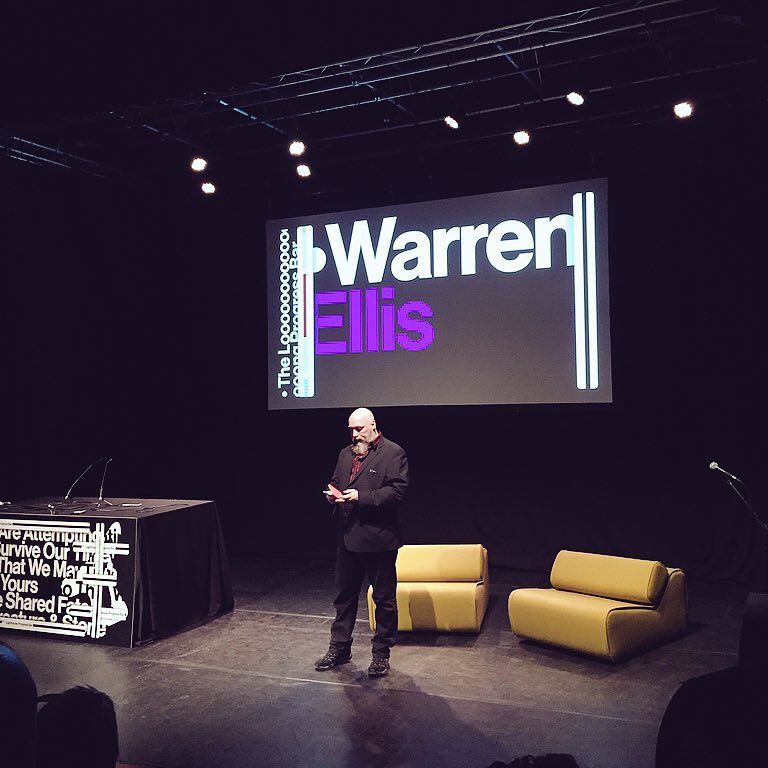
May 22nd, 2011 | comics talk


Rebecca Dart


“The Goddess Of Discord”


May 22nd, 2011 | photography


Anke Merzbach


flickr


The New Aesthetic

May 22nd, 2011 | researchmaterial

James Bridle for RIG:

For a while now, I’ve been collecting images and things that seem to approach a new aesthetic of the future, which sounds more portentous than I mean. What I mean is that we’ve got frustrated with the NASA extropianism space-future, the failure of jetpacks, and we need to see the technologies we actually have with a new wonder. Consider this a mood-board for unknown products…

The rough, pixelated, low-resolution edges of the screen are becoming in the world.

Matt Jones for BERG:

I guess – like NASA imagery – it doesn’t acquire that whiff-of-nostalgia-for-a-lost-future if you don’t remember it from the first time round. For a while, anyway.

‘Sensor-Vernacular’ is a current placeholder/bucket I’ve been scrawling for a few things… an aesthetic born of the grain of seeing/computation. Of computer-vision, of 3d-printing; of optimised, algorithmic sensor sweeps and compression artefacts. Of LIDAR and laser-speckle. Of the gaze of another nature on ours. There’s something in the kinect-hacked photography of NYC’s subways that we’ve linked to here before, that smacks of the viewpoint of that other next nature, the robot-readable world.

It’s the lossy-ness that reveals the grain of the material and process. A photocopy of a photocopy of a fax. But atoms. Like the 80?s fanzines, or old Wonder Stuff 7? single cover art. Or Vaughn Oliver, David Carson. It is – perhaps – at once a fascination with the raw possibility of a technology, and – a disinterest, in a way, of anything but the qualities of its output. Perhaps it happens when new technology becomes cheap and mundane enough to experiment with, and break – when it becomes semi-domesticated but still a little significantly-other…

And James’ dedicated tumblr for exploring the idea.  Both posts are worth reading in full: all kinds of really interesting stuff that I just scraped the surface of here.

What I will say is that, although there is no one future to be predicted or inferred — that the idea of the consensus future is resolutely 20th century and should be put to rest — it’s really nice to see people looking for what’s next again.


Grimsvotn

May 21st, 2011 | researchmaterial

Grimsvotn.  What a great name for a volcano.  This appears to be an image of the eruption from earlier today, taken by Sigurlaug Linnet for mbl.is.

(via kateoplis)


Seduction of the Armageddon Witches

May 21st, 2011 | music

New MATER SUSPIRIA VISION video, art-directed and directed by Diego Barrera.  It’s rather lovely, and takes witch house visuals quite dramatically out of video-appropriation.

MATER SUSPIRIA VISION – Seduction of the Armageddon Witches {2011} from Diego Barrera on Vimeo.


May 21st, 2011 | comics talk


Derek Chatwood


"Sweeney & Crabb" - print


May 21st, 2011 | people I know


Steve Rolston


print


Night Music: Saåad

May 21st, 2011 | music

Because sometimes you want to play out the night with immense, beautiful yet somewhat cursed-sounding ambient drone from the gardens of the ninth circle of hell.  Or something.  The PINK SABBATH EP.  Recorded in Brooklyn and some unnamed and probably doomed point between Stockholm and Turku on the Baltic Sea.  Good night.


May 21st, 2011 | people I know


Ben Templesmith


Misery M.O.D.O.K.
currently on sale at eBay


May 20th, 2011 | microlog

And the previous thirty posts will be rolled into a small POD book sometime in the near future.

Welcome back.  This is warren ellis dot com.


29. Our Streets

May 20th, 2011 | spirit tracks

There’s no such thing as ghosts. UFOs are just lights in the sky. And vodka is probably not improved by strontium. None of that matters as much as the decision you have to make before you start to make the future, before you get carried away by the lights in the sky and the things you can do with your glowing boxes. Whose streets are these, that you’re going to be building your cognitive cities on?

Whose streets? Our streets.

Ultimately, this conference I’m standing at in Berlin, these people I’m talking to, might turn out to be a conference of people who are hunting a ghost.

It’s your job to make that real.

It’s my job to remind you that I’m haunting you.

Thanks for your time.

- end -


28. The Maiden

May 20th, 2011 | spirit tracks

Listen to what the ghosts are telling you.

A man called James Douglas gave the Maiden, an early form of guillotine, to the court of Mary Queen Of Scots in the 1500s. Legend has it that he was also the first person to be executed with it.

As a rule, Western societies tend to need people like you to give the concepts behind digital cities to them.


27. The Locks

May 20th, 2011 | spirit tracks

Governments and corporations colluded to shut off mainline internet and phone service in Egypt, but a couple of hundred people running TOR bridges kept the information moving. Now, maybe you’ve all been having conversations about tying countless services into a digital-city infrastructure and then giving them keys to someone else and how that would work when that’s centralised and some complete strangers now operate the locks.

If you really want to talk to digital ghosts on the streets of your cities, you may end up holding ad hoc digital seances. With your ghost boxes boiling your brains.

A bit of, in fact, radiation communism.


26. Best Case Scenario

May 20th, 2011 | spirit tracks

Ever been to Iceland? The Icelandic government spend a hideous amount of money on fireworks every year. But the road out of Keflavik is still a dirt track. These are the people who’re going to fund your new digital infrastructure? They can’t build fucking roads. Our authorities are sometimes at their most benign when they’re at their most incompetent.

As I was writing this, Laurie was sending through reports and photos of kids being beaten by police on the streets of London via her ghost box. Because Western societies don’t, yet, switch off the internet and the mobile phone network when they want to beat the shit out of their populace. And I often think that it’s not that they don’t want to, so much as they are old and slow and haven’t quite figured out the way the world works yet. Ten years ago in Britain, there was a great outcry when speed cameras became ubiquitous on our roads. Lots of talk of 1984, Big Brother. But the anger kind of died away when it was later found that, not only were the cameras not digital, but that most of them didn’t have any film in. The county of Norfolk had no film in any of its speed cameras for the whole of 2001.

And that might be the best case scenario.


25. Flyposting Is Illegal

May 20th, 2011 | spirit tracks

Flyposting is illegal. Google Maps pins and AR anchors are not.

Cognitive cities require the approval and collaboration of city authorities. The same people who make flyposting illegal.

Spirit roads were overlaid on folkloric paths believed to be travelled by ghosts. It seems oddly apt to me, here in our hauntological future condition, that we might superimpose ghost traffic on our real roads.

Opening the streets to spectral detournements, applying digital sandpaper to the real world, and the fictions of ARGs, Alternate Reality Games. Pirate broadcasting from the husks of old buildings again, like those Essex nutters sending pictures to televisions at four in the morning.

Mediated by ghost boxes, enabling near field instrumental trans-communication with the world of the invisible. Electric scrying pools, a glowing screen for conversation with the voices of the other side.


24. Report On The Situation Of Constructions

May 19th, 2011 | spirit tracks

It’s why some of the digital cities rhetoric is turning more and more to evangelism, partnering with civic authorities, trying to influence the actual owners of bricks and mortar and street furniture. Explaining it. Giving the gift of the digital city to our ruling classes. Which is many places isn’t getting further than, say, publicly posted building permits in New York City having QR codes printed on them. Which will be great until someone steals the permit to make a crack pipe out of it.

Those RFIDs won’t be ours. They’ll be corporate agents of one kind or another. There’s an artist who’s recently made small ripples by cementing USB sticks into the exteriors of buildings, but any intervention will remain on that fairly tiny scale.

Any physical intervention.


23. Whose Streets

May 19th, 2011 | spirit tracks

As I was working on the first draft of this, students were tearing through central London en masse and yelling “Whose streets? Our streets!”

Journalist Laurie Penny was out in the middle of them with a phone, reporting in through Twitter. I was keeping an eye on Twitter as I wrote this, actually, so I could shout at Laurie (who has the self-preservation instinct of a lemming dipped in vodka) occasionally. (She recently cited me in an interview as a provider of “avuncular advice.”  She did not add that she never fucking listens to it.)

And it occurred to me that they’re not our streets. In the sense that we can’t build in them.


22. Psychosonic

May 19th, 2011 | spirit tracks

The ghost box is also a symbol of hauntology.  Ghost Box is the name of one of the pre-eminent music labels associated with sonic hauntology: a music that traffics in the ghostly, in the peculiarly unsettling early electronic music of the Sixties and Seventies, in the strange common culture of 70s British television, in the ejecta of the collision of the rural and folkloric and the electronic and modern.

One touchstone is the children’s tv series THE CHANGES, where a return to primitive non-technological life (or perhaps Terence McKenna’s much-discussed notion of an Archaic Revival) is triggered by the emitting of psychosonics from those great rusting pylons.  The sound makes people want to smash technology, and, after everything has been smashed, the pylons are so repulsive to people that they’re driven (down old tracks?) into the countryside.

(I like to think of Jack Schulze cowering under one, yelling “No!  Fuckers!”)

The music for this series was created by Paddy Kingsland, of the BBC Radiophonic Workshop.  He joined the Workshop in 1970.  Delia Derbyshire was still there, not having yet flown off to become, among other things, a radio operator.  Not quite having closed her first career in music, but getting there.  She’d been a catalysing point for electronic sound in the Sixties.  She’d talked to Pink Floyd, the Beatles, the Stones, and apparently had an orgy with Yoko Ono and other persons unknown on her own living room floor.

“I was always very generous in telling people everything I knew,” she said.

And when everyone knew everything she knew, it seems that it was decided that there was no great use left for her.  And so she left, to become a ghost of electronic sound for some twenty years.


21. Conversations With Things

May 19th, 2011 | spirit tracks

You know what a ghost box is? They pre-date EVP. It’s said that Thomas Edison tried to make one once. There’s a whole community of ghost box makers on the net today, right alongside the ghost detector people and the Instrumental Trans-Communication people (add ITC to EIF and RFID). A ghost box is an electromagnetic device for communicating with ghosts through radio waves. Some ghost boxes claim two-way communication, in fact. Conversations with things that are not alive as we commonly understand the word “alive” to mean.

I imagine most of the people here at this conference in Berlin have one of those in their pockets.

And by “conversations with things that are not alive” and all that, I don’t mean phone calls with family members and dumped boyfriends.

That’s a bit of a mundane digital-city future, though, I suppose – having to communicate with the ghosts through a glowing box. And also a bit expensive for many city dwellers, I would think. Although possibly I’m just cheap.